
Arabic Keyboard
Different Arabic Fonts: A Guide to Digital Typography
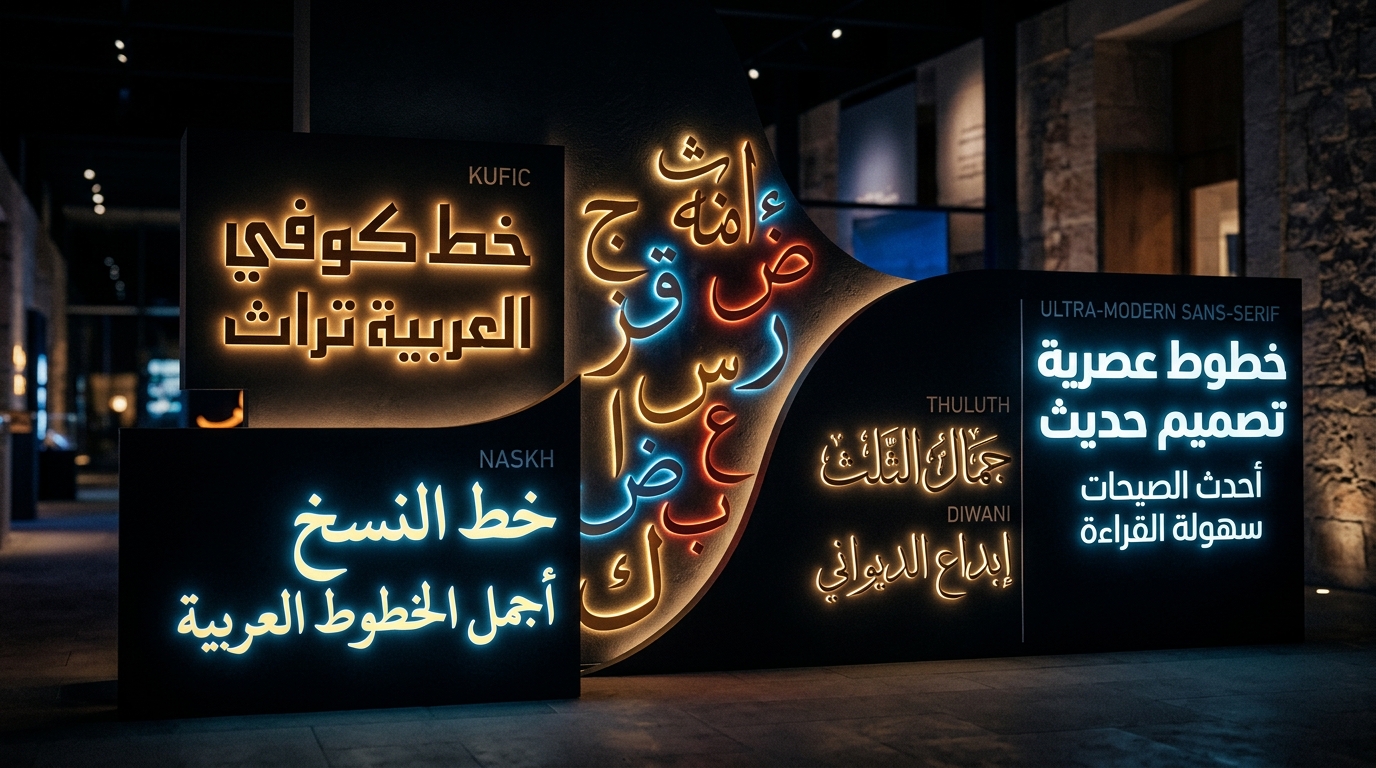
In the era of user experience (UX) and interface design, typography plays a crucial role in transmitting a message. For the Arabic language, this challenge takes on a unique dimension. Arabic writing is inherently cursive, fluid, and historically linked to the sacred art of Arabic calligraphy. Transposing this plastic complexity onto our modern screens has required decades of research in text engineering and typeface design.
Today, whether you are designing a multilingual website, a mobile application, or an advertising campaign in the Middle East, understanding different Arabic fonts is essential. This comprehensive guide explores traditional font families adapted for digital use and essential modern web fonts to optimize your visibility and SEO.
1. Fonts Inspired by Classical Calligraphic Styles
The majority of contemporary Arabic fonts rely on the major historical styles of Khatt (Arabic writing). There are two main fundamental families that structure the editorial landscape:
Naskh Style Fonts (The Serifs of Arabic)
Naskh is the reading style par excellence. Originally designed for its high readability in copying books and the Quran, it has been faithfully transposed to the digital format. Naskh-style fonts retain the contrast of thick and thin strokes characteristic of the traditional reed pen (qalam). They are the equivalent of Western "Serif" fonts (like Times New Roman).
Emblematic Example: The Amiri Font
Amiri is a high-quality, open-source web font that revives the superb typography of the Bulaq national printing press in Egypt from the early 20th century. It is ideal for long texts and literature.
Kufi Style Fonts (Geometric Sans-Serifs)
The Kufi style, rigid, angular, and structural, has been beautifully reinvented by digital designers. Its heavy geometric structure is perfectly suited for logos, article titles, branding, and contemporary user interfaces.
2. Modern Web Fonts and Arabic "Sans-Serifs"
With the explosion of responsive web design and adaptations of punctuation and writing in Arabic, designers have created a new category of fonts: simplified contemporary Arabic fonts, freeing themselves from the historical constraints of manual tracing to maximize clarity on small screens (smartphones).
Cairo (The Interface Reference)
Cairo is one of the most popular Arabic fonts on Google Fonts. It cleverly merges the geometric spirit of Kufi with the compactness required for modern screens. It offers a wide range of weights (Light, Regular, Bold, Black), which is rare and valuable for website hierarchy.
Tajawal and Montserrat Arabic
Tajawal offers a perfect balance between a fluid aesthetic and clean geometry. These fluid fonts allow comfortable reading in navigation menus, dashboards, and mobile applications without straining the user's eye.
Comparison of Arabic Fonts on Google Fonts
To guide you in choosing the ideal typography for your website or application, here is a summary table of the best-performing free fonts:
| Font Name | Base Style | Number of Weights | Recommended Usage | UX Rendering / Readability |
|---|---|---|---|---|
| Cairo | Modern Kufi | 9 (From Thin to Black) | Titles, menus, mobile applications | ⭐⭐⭐⭐⭐ (Excellent on screen) |
| Amiri | Classical Naskh | 4 (Regular, Italic, Bold) | Feature articles, poetry, books | ⭐⭐⭐⭐⭐ (Perfect for dense text) |
| Tajawal | Sans-serif Lineal | 7 (From Light to Black) | Web paragraphs, e-commerce | ⭐⭐⭐⭐ (Very fluid) |
| IBM Plex Sans Arabic | Technical / Neutral | 7 weights | News sites, tech interfaces | ⭐⭐⭐⭐⭐ (Surgical precision) |
3. Arabic Typography and SEO: Web Integration Rules
The choice and technical configuration of your Arabic fonts directly influence your natural search engine optimization (SEO) and conversion rates:
- Always manage line spacing (line-height): Arabic characters have much more pronounced upper and lower strokes (ascenders and descenders) than Latin letters. An Arabic font requires a minimum
line-heightof 1.6 to 1.8 in CSS to prevent lines from overlapping and becoming illegible. - Slightly increase the font size (font-size): At equal size (e.g., 14px), an Arabic font visually appears much smaller and more complex than a Latin font. To ensure a good mobile accessibility score (Google's Core Web Vitals), set your Arabic paragraphs to at least 16px or 17px.
- Optimize loading (Font Display): Complete Arabic font files integrate thousands of glyphs and complex Unicode ligatures. They are often heavy (sometimes several megabytes). Use the CSS instruction
font-display: swap;to avoid blocking the initial text display while the font file is loading.
Frequently Asked Questions (FAQ)
Are there default "Web-Safe" fonts for Arabic?
Yes. If you do not wish to load external fonts (Google Fonts), operating systems integrate reliable fallback fonts: Arial, Tahoma, and Times New Roman have excellent native Arabic glyphs. Windows also includes the reference font Traditional Arabic. In CSS, always declare: font-family: 'Cairo', Tahoma, Arial, sans-serif;.
Why is the Italic style discouraged in Arabic typography?
Italics are a purely Western concept. Since Arabic writing is already cursive and slanted by nature, forcing an artificial slant via CSS code (font-style: italic) distorts the natural aesthetic of letter connections and severely degrades readability. Prefer using bold (font-weight) or color variations to emphasize a word.
How do you pair (font pairing) a Latin font and an Arabic font?
The golden rule is to match the structural spirit. If your title in English uses a geometric Sans-Serif font (such as Montserrat or Helvetica), pair it with a modern geometric Arabic font (such as Cairo or Tajawal). If you use a literary Serif font (such as Georgia), pair it with a Naskh-style font (such as Amiri).
Recommended Arabic Tools & Resources
Essential online tools to enhance your Arabic typing, translation, and learning experience:
- Arabic Keyboard Online – type Arabic characters easily with our smart virtual keyboard.
- Arabic Translator Online – translate Arabic words, sentences, and texts instantly.
- Arabic Text Converter – fix Arabic script shaping and direction for design and editing tools.
Conclusion
Mastering different Arabic fonts is a valuable skill at the crossroads of traditional art and modern web engineering. By choosing a font adapted to your medium (classical Naskh for editorial comfort or simplified Kufi for modern interfaces), and scrupulously adjusting sizes and line spacing in CSS, you will offer an impeccable user experience. Neat typography retains the visitor, smoothens reading, and constitutes a powerful lever for the success of your international digital strategy.
To start typing and practicing right away, try our free Arabic keyboard online.