
Arabic Keyboard
Dialectal Differences in Arabic: The Guide to Understanding Regional Variations
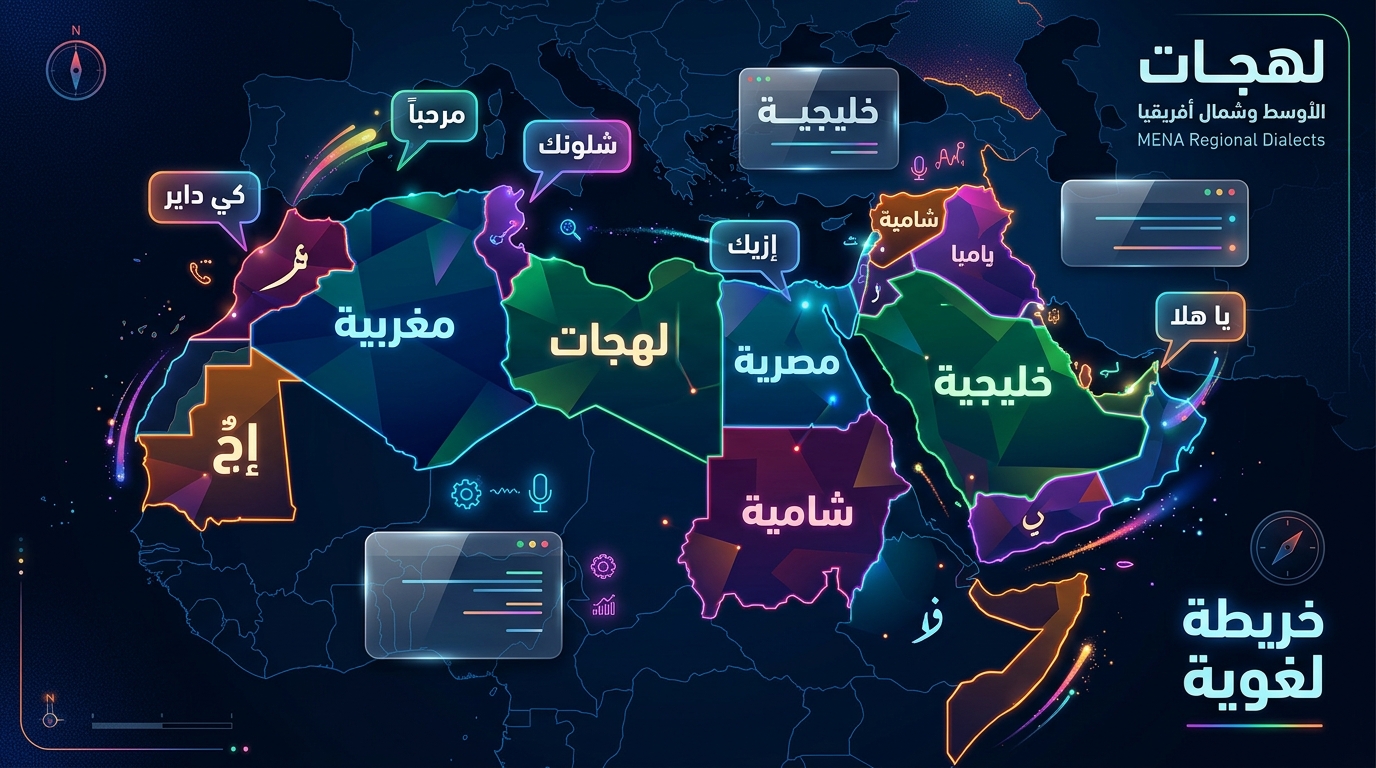
The Arabic language is often perceived as a homogeneous block shared by hundreds of millions of speakers. However, the linguistic reality on the ground is infinitely more nuanced. Dialectal differences sketch a fascinating cultural mosaic where a word used in Casablanca might be completely misunderstood in Baghdad. This diversity constitutes the richness and complexity of everyday spoken Arabic.
For students, travelers, or professionals, navigating through these variations can be confusing. This complete guide deciphers the phenomenon of diglossia and details the major groups of Arabic dialects.
1. The Phenomenon of Diglossia: Standard Arabic vs. Dialects
To understand dialectal differences, one must first grasp the concept of diglossia, which has shaped the history of the Arabic language. The Arab world lives under a system where two forms of the same language coexist:
- Modern Standard Arabic (MSA) / Al-Fusha: This is the official, universal, and written language. It is used in books, newspapers, political speeches, education, and TV news. Everyone understands it thanks to schooling, but no one speaks it as their mother tongue.
- Colloquial Arabic / Al-Amiya or Darija: This is the language of the heart, the home, the street, songs, and daily conversations. It is generally not codified in writing and varies significantly from one region to another.
2. The Four Major Dialect Groups of the Arab World
Although each country has its own subtleties, linguists generally group colloquial Arabic into four major geographical families:
The Maghrebi (Darija)
Spoken in Morocco, Algeria, Tunisia, and Libya, the Maghrebi dialect is distinguished by a strong influence from Berber (Tamazight), as well as massive borrowings from French and Spanish. Its phonetics are characterized by a strong elision of short vowels, making it particularly fast and difficult to understand for Middle Eastern Arabs.
The Egyptian (Masri)
Thanks to the historical influence of Egyptian cinema, music (Umm Kulthum), and television series, the Cairo dialect is the most widely understood across the entire Arab world. Its most famous characteristic is the pronunciation of the letter Jeem (ج) as a hard "G" (as in "gate").
The Levantine (Chami)
Spoken in Lebanon, Syria, Jordan, and Palestine, the Levantine dialect is often perceived as soft and melodious. It has preserved traces of Aramaic (the ancient language of the region) and features very distinct pronunciation nuances depending on whether you are in the city or the countryside.
The Gulf (Khaliji) and Iraqi
Spoken in Saudi Arabia, the United Arab Emirates, Kuwait, Qatar, and Oman, Khaliji remains phonetically and grammatically closer to classical Arabic than other dialects, due to the peninsula's historical geographical isolation.
Linguistic Comparison: One Word, Multiple Realities
To concretely illustrate these dialectal differences, here is how some common Arabic expressions are translated depending on the region:
| French | Standard Arabic (Fusha) | Maghrebi (Darija) | Egyptian | Levantine |
|---|---|---|---|---|
| How are you? | Kayfa haluk? | Kifach daier? / Labas? | Izzayak? (m) / Izzayik? (f) | Kifak? (m) / Kifik? (f) |
| What do you want? | Madha turid? | Chno bghiti? | Ayez eih? | Chou baddak? |
| Now | Al-An | Daba / Tawa | Delwa'ti | Halla' |
| Very / A lot | Jiddan | Bezzaf / Barcha | Awi | Kteer |
3. Why Such Dialectal Differences?
The emergence of these variations can be explained by three major factors:
- The linguistic substrate: When the Arabic language spread during the Islamic conquests, it superimposed itself on the local languages already spoken (Coptic in Egypt, Phoenician and Aramaic in the Levant, Berber in North Africa). These languages deeply colored the local spoken Arabic.
- Colonization and modern history: Waves of influence from the Ottoman Empire, followed by French, British, and Italian colonizations, injected hundreds of European words into everyday vocabulary.
- Geography: Immense distances and natural barriers (deserts, mountains) historically isolated populations, favoring autonomous linguistic evolution.
Frequently Asked Questions (FAQ)
Which Arabic dialect should you learn first?
The choice depends on your goals. If you are aiming for diplomacy, global business, or media, Modern Standard Arabic is essential. If you want to communicate easily in everyday life everywhere, Egyptian or Levantine are excellent choices due to their high level of mutual intelligibility.
Do two Arabs from different countries always understand each other?
In general, yes. Although pure Moroccan Darija can pose problems for a Dubai resident, both speakers will naturally adapt their language (a phenomenon called linguistic accommodation) by using words closer to Egyptian or classical Arabic to understand each other.
Is the dialect written on the Internet?
Yes, massively. With the advent of social networks and messaging apps, dialects are written more than ever before, often using the Arabic alphabet or "Araby" (Arabizi)—a system that uses Latin letters and numbers (like 3 for the 'ayn or 7 for the ha) to transcribe Arabic sounds.
Recommended Arabic Tools & Resources
Essential online tools to enhance your Arabic typing, translation, and learning experience:
- Arabic Keyboard Online – type Arabic characters easily with our smart virtual keyboard.
- Arabic Translator Online – translate Arabic words, sentences, and texts instantly.
- Arabic Text Converter – fix Arabic script shaping and direction for design and editing tools.
Conclusion
Approaching the dialectal differences of the Arabic language should not be seen as a barrier, but rather as an entry point into the incredible cultural diversity of the Arab world. Classical Arabic unites minds through writing, while dialects unite hearts through speech. Mastering or simply understanding these linguistic bridges is the key to experiencing authentic immersion among its speakers.
To start typing and practicing right away, try our free Arabic keyboard online.